The Logic Stage
Horizon Prep’s Logic School provides a classical Christian middle school education for 6th–8th grade students in the San Diego area.
A Formative Stage for Reasoning, Discernment, and Growth
Middle school students are naturally beginning to ask deeper questions: Why does this matter? How do I know what is true? What do I believe? Where do I fit in the world?
In classical education, the Logic stage meets students in this developmental moment. Rather than avoiding their questions, Horizon Prep trains students to ask better ones. They learn to identify assumptions, evaluate arguments, recognize fallacies, compare ideas, defend positions respectfully, and discern truth through the lens of Scripture.
This is a critical season. Students are no longer simply absorbing foundational knowledge; they are beginning to organize, test, connect, and apply it. Horizon Prep’s Logic School helps students grow in confidence, responsibility, humility, wisdom, and conviction.
Key Distinctives
Formal Logic & Reasoning
Students study logical reasoning each year, learning how arguments are formed, how fallacies distort truth, and how to reason with clarity, humility, and conviction.
Harkness Discussion
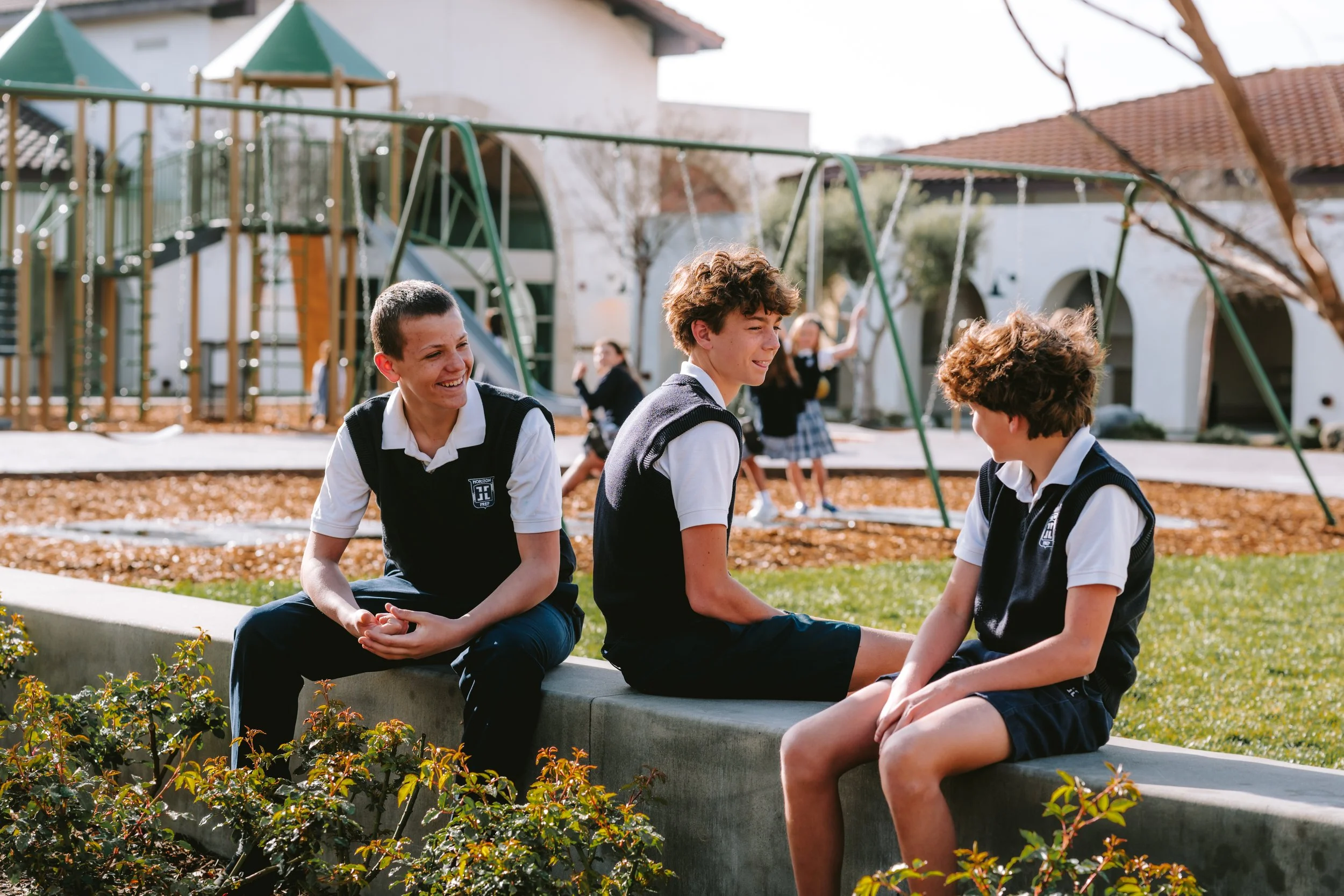
Students engage in meaningful classroom discussion around literature, history, primary sources, Scripture, and ideas. This helps students develop listening, speaking, analysis, and decorum.
Integrated Humanities
English, history, Bible, logic, and the arts are not treated as disconnected subjects. Students examine human achievement, culture, literature, history, worldview, and moral philosophy in context.
Mastery-Based Learning
Math and science emphasize mastery rather than short-term memorization. Students are expected to learn, retain, and apply content through cumulative assessment and consistent review.
Biblical Worldview Formation
Students are taught to see all knowledge through the lens of God’s truth. Bible, humanities, science, technology, and student development all work together toward the central aim of wisdom.
Exploration & Student Development
Daily electives, student life curriculum, service opportunities, technology integration, athletics, camps, and leadership experiences help students discover interests and grow as whole people.
Curriculum Overview
Logic School curriculum is intentionally designed for students who are ready to question, compare, analyze, and reason. Across sixth through eighth grade, students grow through rigorous humanities, formal logic, math pathways, science, Bible, Latin, Spanish, technology, electives, and student development.
The result is a middle school experience that is academically strong, spiritually formative, and developmentally wise.
-
Students study English literature and language arts, history, Bible, logic, and the arts as integrated disciplines. Through great literature, primary source documents, writing, discussion, geography, current events, and worldview reflection, students develop the tools to understand culture and engage it wisely.
-
Students analyze literature across genres, study literary devices and elements, grow in grammar and vocabulary, and continue developing writing through 6+1 Traits and the Progymnasmata. Regular discussion strengthens oral communication, analysis, listening, and decorum.
-
Students engage history through primary source documents, timelines, maps, art, and discussion. Sixth grade focuses on ancient civilizations, seventh grade moves into European history, and eighth grade builds into United States history. Students are challenged to connect the past with current events, culture, politics, economics, art, music, and architecture.
-
Bible instruction forms the foundation for wisdom, worldview, prayer, service, and moral discernment. Students study Scripture while learning to understand how God’s truth informs every area of knowledge and life.
-
Students take formal logic each year. Sixth grade begins with fallacies and the foundations of argument. Students study premises, conclusions, inductive and deductive reasoning, inferences, truth, and validity. Seventh and eighth grade students build toward symbolic logic, sound reasoning, and debate.
-
Students are placed into one of three math pathways as they enter sixth grade, helping establish a trajectory toward twelfth grade. Math uses a mastery model designed to build retention, fluency, and readiness for future coursework.
-
Science courses use inquiry-based instruction and a mastery model. Students study Earth Science, Life Science, and Physical Science while learning deductive and inductive reasoning, scientific method, worldview implications, and the limits of scientific exploration. Technology is integrated across coursework through research, modeling, design, engineering, communication, and ethical use.
-
Language study continues through Latin and Spanish, strengthening grammar, vocabulary, language structure, translation, communication, and preparation for advanced language study.
-
Students participate in a daily elective period with opportunities across arts, music, STEM, applied arts, performing arts, technology, robotics, design, problem-solving, and more. Electives give students room to explore interests, refine skills, and experience something new.
Curriculum Tracking
Logic School learning is intentionally sequenced. Each year builds in academic depth, personal responsibility, logical reasoning, writing, discussion, worldview formation, and readiness for Rhetoric School.
This progression helps families see how students move from foundational reasoning in sixth grade toward greater independence, analysis, debate, and leadership in eighth grade.
Grade
Humanities & Writing
Math & Science
Bible, Logic & Worldview
Student Life & Enrichment
6th Grade
Literature studies include expository texts, biography, poetry, The Horse and His Boy, A Wrinkle in Time, and The Bronze Bow. Students develop literary analysis, 6+1 Traits writing, Progymnasmata exercises, and a country research report. History focuses on ancient civilizations and primary sources.
Students enter one of three math pathways designed to meet them at the right level of readiness: Arithmetic Foundations, Introductory Pre-Algebra, or Pre-Algebra. The emphasis is on mastery, retention, mathematical fluency, and building the habits needed for long-term success. In Earth Science, students study the earth from the inside out, including oceans, weather, earthquakes, volcanoes, rocks and minerals, and the earth’s place in the solar system. Technology begins to support research, modeling, presentations, and responsible digital learning.
Students begin the Logic School Bible sequence with an Old Testament Survey, grounding them in the story, structure, major themes, and redemptive arc of Scripture. Logic begins with The Art of Argument, where students learn to recognize fallacies, understand how arguments are built, and begin distinguishing persuasive language from sound reasoning. The focus is foundation: biblical literacy, moral categories, and early discernment.
Student Life focuses on becoming a Master Student. Sixth graders learn the habits of middle school success: organization, responsibility, study habits, time management, technology use, and self-advocacy. Electives, community service, ACSI events, outdoor education, Camp San Diego, athletics, clubs, and performing arts help students transition into middle school with confidence and connection.
7th Grade
Literature includes classic short stories, poetry, The Hobbit, Robin Hood, Rikki Tikki Tavi, A Midsummer Night’s Dream, and Fish Cheeks. Writing builds through literary analysis and Progymnasmata exercises including Common Topic, Encomium, and Invective. History moves into European history.
Students continue on an appropriate math pathway through Introductory Pre-Algebra, Pre-Algebra, or Algebra 1. The goal is not simply acceleration, but accurate placement, cumulative review, and durable understanding that prepares students for upper-level math. In Life Science, students study living things, including cells, heredity, theories of origins, and the human body. Students continue developing scientific reasoning through observation, inquiry, evidence, and worldview-aware discussion.
Students continue the Bible sequence with a New Testament Survey, connecting the life, teaching, death, and resurrection of Christ to the larger biblical story. Logic continues through The Art of Argument as students deepen their ability to identify faulty reasoning, evaluate claims, and engage ideas with clarity and humility. The focus is connection: seeing how Scripture, history, literature, and logic shape a Christian understanding of truth.
Student Life moves from personal organization toward practical wisdom through Financial Literacy. Seventh graders begin applying responsibility to real-world decision-making, stewardship, planning, and personal discipline. Electives, service hours, ACSI events, Catalina Island, athletics, clubs, and performing arts give students broader opportunities to explore interests, strengthen friendships, and practice maturity.
8th Grade
Literature includes short stories, epic literature, essays, poetry, Animal Farm, Out of the Silent Planet, The Outsiders, The Little Prince, and To Kill a Mockingbird. Writing includes comparison, characterization, personal narrative, literary analysis, thematic amplification, and nonfiction exposition. History builds into United States history.
Students continue into Pre-Algebra, Algebra 1, or Geometry depending on readiness and pathway placement. By eighth grade, math instruction is preparing students for the expectations of Rhetoric School and the sequence of high school mathematics. Physical Science uses a mastery-oriented curriculum as students study chemistry, physics, energy, and the non-living systems of God’s creation. Students continue practicing deductive and inductive reasoning, scientific method, data analysis, and responsible use of technology.
Students move from biblical survey into Christian worldview formation, learning to examine ideas, culture, truth, and calling through a biblical lens. Readings such as The Great Divorce help students consider spiritual realities, moral choices, and ultimate questions. Logic and rhetoric continue through Argument Builder, preparing students to construct sound arguments, engage debate, and enter Rhetoric School with stronger discernment and communication. The focus is conviction: learning to think, speak, and live from a formed worldview.
Student Life culminates with Life Calling and Career Planning through The Race to Somewhere. Eighth graders begin considering gifts, interests, vocation, responsibility, and future direction as they prepare for Rhetoric School. Service hours, electives, ACSI events, the Washington D.C./Gettysburg/New York City trip, athletics, clubs, and performing arts provide leadership opportunities and help students step toward greater independence.
Student Development & Spiritual Formation
Forming the Whole Student
Logic School is not only about academic growth. Middle school students are developing identity, habits, friendships, independence, and spiritual maturity. Horizon Prep intentionally supports this stage through student life curriculum, discipleship, leadership, service, and practical life preparation.
Students grow through grade-level development themes such as Master Student, Financial Literacy, and Life Calling and Career Planning. They also participate in chapel, Bible, prayer-life development, community service, camps, and opportunities to practice leadership and responsibility.
The goal is not simply to help students succeed in school. The goal is to help them grow in wisdom, character, confidence, and conviction.
Electives, Athletics & Student Life
Possible Elective Areas
Band, choir, and music appreciation
Drawing, painting, ceramics, photography, and graphic design
Dance, creative writing, and performing arts
Woodworking, organic gardening, and applied arts
Coding, CAD, robotics, problem solving, and STEM
Physical activity and skill-based enrichment opportunities
Student Life Highlights
Competitive interscholastic athletics
Spring musical and performing arts
ACSI Spelling Bee, Speech Meet, Creative Writing, Math Olympics, and Art Festival
Outdoor education and grade-level trips
Community service hours
Clubs and enrichment activities
Athletics
Athletics are an important part of the Logic School experience, giving students opportunities to compete, grow in discipline, build friendships, and represent Horizon Prep with character.
Preparing Students for Rhetoric School
Prepared for the Next Stage
The Logic School years are designed to prepare students for the independence, leadership, and communication expected in Rhetoric School.
By the end of eighth grade, students have practiced analyzing literature, reading primary sources, writing with structure, discussing ideas with decorum, identifying fallacies, forming arguments, engaging worldview questions, using technology responsibly, serving others, and taking greater ownership of their learning.
They are prepared not only to know more, but to think more clearly, speak more confidently, and live more faithfully.
Come See Logic School in Action
The best way to understand Horizon Prep’s Logic School is to experience it firsthand. We invite your family to visit campus, meet our team, and see how middle school students are challenged academically, guided spiritually, and equipped to think clearly and live with conviction.